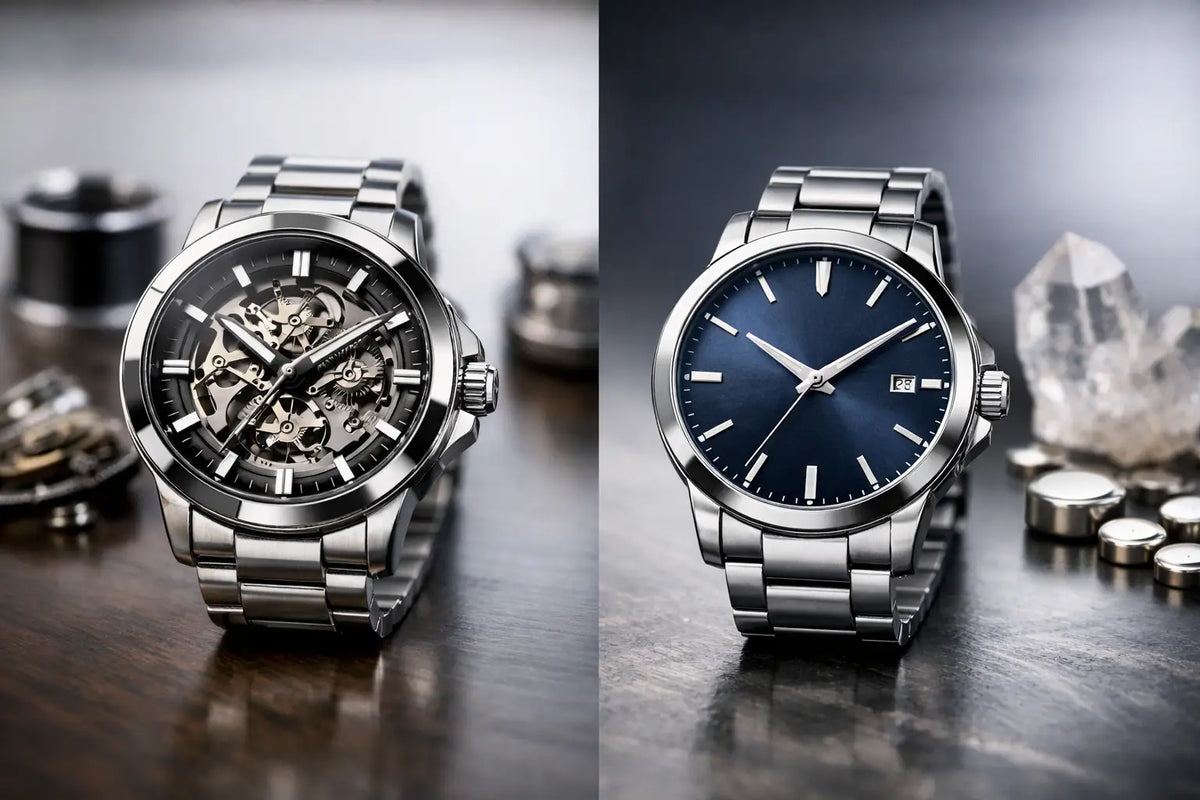
A watch does more than tell time. It sits at the center of your wrist, catches the light when you reach for a glass, and quietly signals how you move through a room. In the automatic watch vs quartz watch decision, the better choice is not about proving you know more about watches. It is about choosing the kind of presence you want to wear.
For some, that means the quiet precision of quartz: set it, wear it, trust it. For others, it means the living mechanics of an automatic movement, where motion keeps time in motion. Both can look sharp. Both can elevate a fit. The difference is in the experience behind the dial.
Automatic Watch vs Quartz Watch: The Core Difference
An automatic watch is mechanical. Inside the case, a network of gears, springs, and a weighted rotor work together to power the movement. As you wear the watch, the rotor turns with your wrist and winds the mainspring. No battery is required for the movement itself.
A quartz watch runs on a battery. That battery sends electricity through a quartz crystal, which vibrates at a highly consistent frequency. The movement converts those vibrations into measured seconds, powering the hands or display with exceptional accuracy.
The distinction sounds technical, but it changes how the watch feels in daily life. An automatic is a small machine with personality. A quartz watch is disciplined, exact, and built to perform without asking for attention.
Why Choose an Automatic Watch?
An automatic watch is for the person who sees details. You do not wear it because it is the simplest option. You wear it because the mechanism matters. There is weight to it, literally and visually, and a sense of craft beneath the dial.
This is especially true with skeleton-dial watches. An exposed movement turns the interior of the watch into part of the design. Gears, balance wheels, and moving components create depth that a flat dial cannot replicate. It feels architectural. Controlled. Built for presence.
Automatic watches also appeal to collectors because the movement can last for years with proper care. Rather than replacing a battery, you maintain the mechanism through periodic servicing. That long-term relationship is part of the appeal. An automatic watch is not just an accessory you put on. It is an object you live with.
There are trade-offs. Automatic movements are generally less accurate than quartz movements, often gaining or losing a few seconds per day. If you rotate between several watches, an automatic may stop after being left unworn for a day or two, depending on its power reserve. Resetting the time is a small ritual, but it is still a ritual.
Why Choose a Quartz Watch?
Quartz is the clean answer when precision and ease lead the decision. A quality quartz watch can remain accurate to within seconds per month, compared with the daily variation expected from many mechanical movements. You put it on, and it is ready.
Quartz watches are also usually slimmer. Without the layered architecture of a mechanical movement, the case can sit closer to the wrist. That makes quartz a strong choice for ultra-thin profiles, tailored sleeves, and anyone who wants a watch that feels sharp rather than heavy.
Maintenance is simpler, too. Most quartz watches need a battery change every few years, along with basic care to keep the case and strap looking right. There is no need to wear the watch regularly to keep it running, and no concern about winding it after time off your wrist.
That practicality does not make quartz less stylish. Minimalist design often benefits from quartz because the movement supports clean proportions. A precise, stripped-back dial on a slim case has its own authority. No unnecessary drama. Just a watch that holds its line.
Precision Is Not the Same as Character
If the question is purely about timekeeping, quartz wins. It is more accurate, more consistent, and easier to rely on when every minute matters. For travel, work, packed schedules, or a watch you want to grab without thinking, that edge is real.
But a watch is rarely a purely rational purchase. An automatic can be slightly less precise and still feel more compelling because you can see or sense the engineering behind it. Its sweeping seconds hand, often smoother than the one-second tick of quartz, adds a different kind of visual energy.
Think of it this way: quartz is about command over time. Automatic is about connection to it. Neither position is better. The right answer depends on whether you value technical precision or mechanical expression more.
Maintenance, Durability, and Real Life
Both types benefit from care, but they ask for it in different ways. An automatic watch should be serviced by a qualified professional over time, particularly if you want to protect its accuracy and longevity. It is also wise to avoid hard impacts, since its movement includes many small mechanical parts.
A quartz watch is generally more forgiving for everyday wear. Battery changes are straightforward, though it is best not to leave a dead battery inside for years. In some cases, an old battery can leak and damage the movement. If you notice the seconds hand skipping in larger jumps, it may be signaling that the battery is low.
Water resistance is separate from the movement type. An automatic watch is not automatically more water-resistant, and a quartz watch is not automatically safer around water. Check the watch's stated rating, keep the crown properly secured, and treat water exposure with intention rather than assumption.
Which Movement Matches Your Style?
Automatic watches suit looks with texture and depth. Think structured black tailoring, a fitted knit, leather footwear, or layered jewelry with a strong silhouette. A skeleton dial can become the focal point without feeling loud, especially when the rest of the fit stays clean. It communicates that you chose the details on purpose.
Quartz watches work when your style is more streamlined. Their thinner cases pair naturally with crisp shirts, minimal jewelry, monochrome outfits, and polished daily uniforms. A simple black, silver, or gold-tone dial can carry a refined look from the office to dinner without competing with everything else you wear.
At VALTRYXX, the strongest watch choices are not made by movement alone. They are made by proportion, finish, dial design, and the confidence of the person wearing them. The movement is the foundation. Your styling gives it force.
Choose Based on How You Will Wear It
Choose an automatic watch if you enjoy the mechanics, plan to wear it often, and want your watch to feel like a statement piece with a story under the glass. It is the move for someone who notices a skeleton dial from across the room and understands why that detail matters.
Choose quartz if you want dependable accuracy, lower-maintenance ownership, and a slimmer watch for constant rotation. It is ideal when you want to build a sharp everyday accessory lineup without stopping to reset the time after a few days away.
If this is your first watch, quartz is often the easier entry point. It gives you the freedom to focus on fit, case size, color, and strap without learning the habits of mechanical ownership. If you already know that watches are more than an afterthought for you, an automatic can make the experience feel more personal.
There is also nothing wrong with owning both. A quartz watch can be your daily operator: precise, polished, always ready. An automatic can be the piece you reach for when the setting calls for more depth, more conversation, and a little more edge.
Your timepiece should not just match your outfit. It should match your intent. Choose the movement that supports how you show up, then wear it like every second belongs to you.