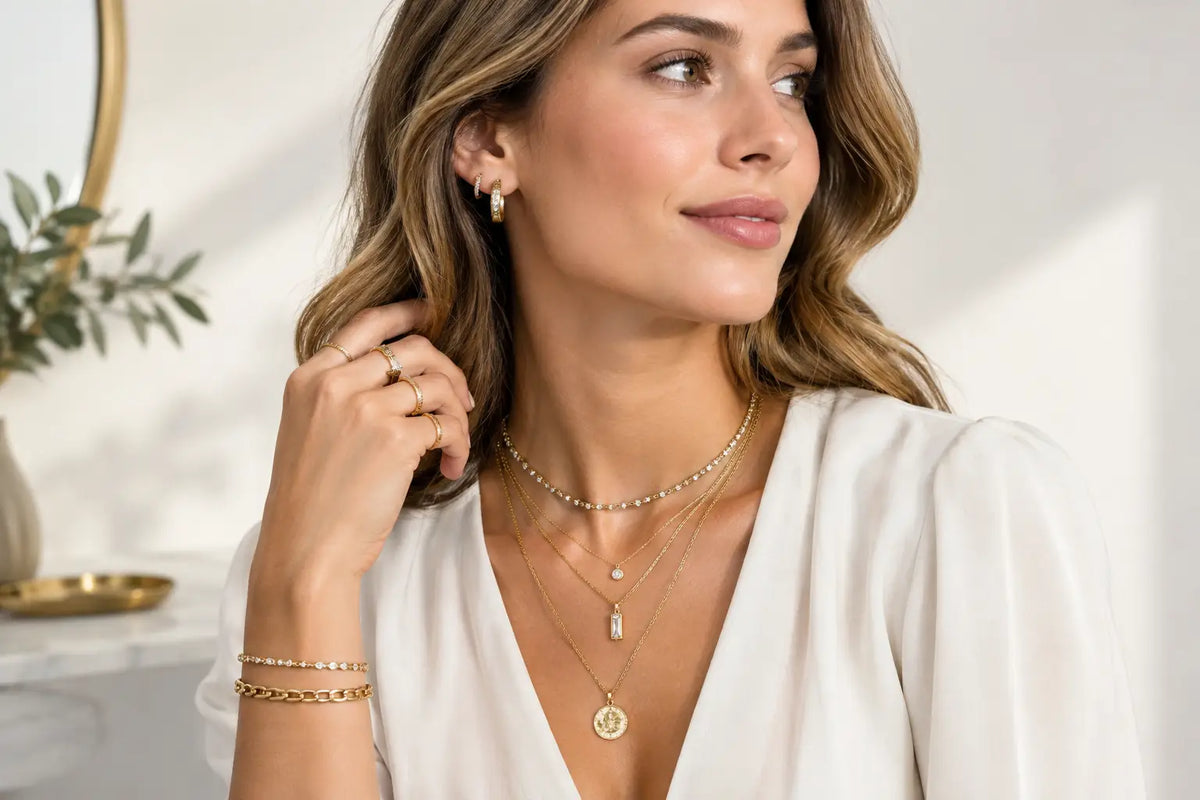
A layered look should never feel like you emptied a jewelry box onto your body. The strongest jewelry layering trends 2026 are built on control: a clean neckline, deliberate scale, and enough contrast to make people look twice. More pieces are not the point. Presence is.
This year’s direction moves away from overly delicate stacks that disappear in a mirror selfie and away from random maximalism that competes with the outfit. The new standard is considered impact. Think a strong chain against a fine pendant, a crisp watch beside one or two measured bracelets, or a sculptural ring stack that leaves room for your hands to move.
Jewelry Layering Trends 2026 Are More Intentional
Layering is becoming less about following a strict formula and more about setting a visual hierarchy. Every stack needs a lead piece. It might be a substantial gold-plated chain, a sharp signet ring, a skeleton-dial watch, or a bold cuff. Once that piece is in place, the rest of the look exists to support it.
The result is polished rather than precious. Jewelry is being worn with tailored separates, washed denim, fitted knitwear, open-collar shirts, and clean evening looks. The pieces do not need to match perfectly. They need to look like they belong to the same person.
That distinction matters. Matching every finish, texture, and silhouette can make a stack feel flat. Adding too many unrelated details can make it feel accidental. The sweet spot is tension with a reason behind it.
The anchor-piece rule
Start with one piece that holds visual weight. A wide-link chain at the collarbone gives lighter necklaces a foundation. A statement watch gives a bracelet stack direction. A substantial ring on the index or middle finger can make slimmer bands feel intentional instead of timid.
The anchor should suit where you are going. For work or a dinner reservation, a refined chain or ultra-thin watch may lead. For a night out, a larger pendant, heavier bracelet, or more architectural ring can take control. The question is not whether the piece is loud. It is whether it is decisive.
Necklaces: Contrast Beats Clutter
Necklace layering remains the center of the 2026 jewelry conversation, but the silhouettes are cleaner. The most effective combinations use two or three distinct lengths, each with a different job. One chain establishes texture. Another introduces detail. A final piece, if needed, creates depth through a pendant or stronger profile.
A close-fitting chain paired with a medium-length pendant has more authority than four nearly identical fine chains. The difference in length creates space, and space is what lets quality read from across the room.
Gold tones remain essential, particularly for skin-warming contrast and a luxury-coded finish. Silver is equally relevant when the outfit is cooler, more monochrome, or sharper in mood. Mixed metals are no longer a styling mistake, but they require discipline. Pair one dominant finish with a smaller accent in the other. A silver pendant on a gold chain stack can work. Equal amounts of both can look undecided.
Texture is the other tool. Combine a smooth snake-style chain with a link chain, or place a clean pendant against a chain with more visible structure. If every necklace is delicate, the stack risks disappearing. If every necklace is heavy, the neckline can feel armored. It depends on your frame, collar, and the amount of skin the outfit reveals.
Let the neckline set the limits
A crewneck gives you room for a slightly longer chain that rests above the fabric, while an open collar creates a natural frame for two lengths. High necklines call for restraint - choose one bolder piece over several chains fighting for space. With a deep neckline, use the vertical line with intent rather than filling every inch.
The strongest move is often to stop one layer earlier than expected. A stack that looks almost too minimal in your hand often looks exactly right when the full outfit is on.
Wrist Stacks Gain Precision
The wrist is where jewelry layering trends 2026 become especially personal. Watches are no longer treated as separate from jewelry. They are the foundation of the stack. A dark dial, metal case, or skeleton design brings structure before a single bracelet is added.
Build around the watch rather than burying it. On the same wrist, one slim chain bracelet or a clean cuff can add motion without making the watch difficult to read. A more assertive watch can stand alone, with a bracelet placed on the opposite wrist for balance. This is often the smarter choice when your sleeves are fitted or your outfit already includes a visible belt, bag hardware, or bold footwear.
The new preference is for wrist stacks that feel designed, not noisy. Avoid filling the entire forearm with pieces that slide, clink, and catch on every cuff. Leave a small margin of bare skin near the hand. It makes the arrangement feel more expensive.
For a more graphic look, combine a dark watch face with polished metal bracelets. For warmer styling, pair gold-plated jewelry with a watch that has a clean, restrained profile. The contrast between precision and shine creates the kind of detail people notice late, not all at once.
Rings Get Sculptural, Not Fussy
Ring layering is shifting toward bolder proportions and fewer pieces. Rather than covering every finger in thin bands, choose two to four rings with a clear difference in scale. A signet silhouette, a wider band, or an angular face can carry the stack. Slim rings then become punctuation.
Placement changes the energy. A ring on the index finger feels directive. The middle finger adds balance and weight. Pinky rings bring an old-world edge when the design remains clean. There is no universal formula, but each hand should have a focal point.
If you wear rings on both hands, keep one side quieter. A dominant watch hand with a single strong ring on the other creates balance. Multiple statement rings on both hands can work for an evening look, but the outfit needs to be spare enough to hold it.
Nails, sleeve length, and hand movement all influence the result. Rings are close-range jewelry. They should feel good during a handshake, a drink, a commute, and a long day at a keyboard. Style without wearability does not hold power for long.
Personal Symbols Return With Restraint
Initials, medallions, talisman-inspired forms, and meaningful motifs are gaining ground, but the 2026 version is not sentimental excess. Personal pieces work best when they are treated as part of the architecture of the stack.
A small symbol can soften a heavier chain. A medallion can give a minimal shirt and blazer combination a point of view. The key is to avoid competing messages. If one pendant carries meaning, let it be the story. Do not add three more symbols just because the neckline has room.
This is where layering becomes more than trend adoption. The best jewelry has a recognizable point of view. It looks chosen over time, even when the pieces are new.
Build a Stack That Looks Like You
Start by deciding what your jewelry should communicate: precision, edge, warmth, authority, or ease. Then choose one anchor and add only the elements that sharpen that message. A gold chain, polished ring, and dark-faced watch can project quiet command. A mixed-metal necklace pairing and sculptural cuff can feel more directional. Neither approach is better. The right one matches your natural style and the setting.
For those building a core collection, prioritize versatile shapes before chasing novelty: one elevated chain, one pendant, one distinctive ring, one clean bracelet, and a watch with enough character to stand alone. VALTRYXX approaches accessories with that same principle - every detail should earn its place.
Treat your layers like the final edit, not the first idea. When the pieces create contrast, leave room to breathe, and make you stand taller, the look is finished.