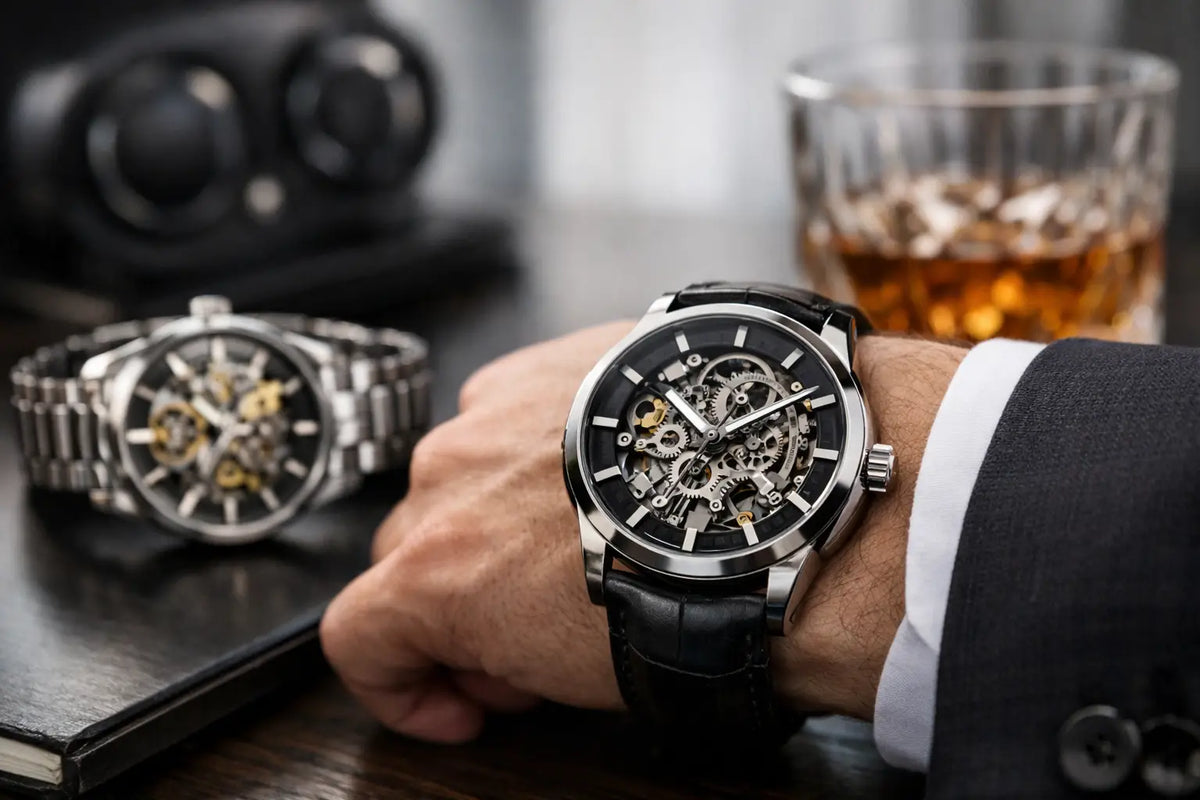
A closed dial tells you the time. Skeleton dial watches show you what makes time move. Beneath the crystal, gears, bridges, balance wheels, and mechanical rhythm become part of the design. The result is not quiet in the conventional sense. It is controlled spectacle - a timepiece for people who understand that presence lives in the details.
For a wardrobe built around sharp lines, dark tones, and intentional accessories, a skeleton watch does more than finish an outfit. It adds structure. It signals that your style is considered, not accidental.
What Makes Skeleton Dial Watches Different
A skeleton dial removes much of the solid material normally used to conceal a watch movement. Instead of looking at a flat face with markers and hands, you see the architecture beneath it. Every exposed component adds depth, movement, and visual tension.
The strongest skeleton designs balance that complexity with restraint. They leave enough open space to reveal the mechanism while preserving a clean read on the hour and minute. When the dial is too crowded, the watch can feel more like a novelty than a statement. When it is well executed, the movement becomes the statement.
There is a distinction worth knowing. A fully skeletonized watch exposes most of its movement, while an open-heart design reveals only a smaller window, usually around the balance wheel. Both can look elevated. The right choice depends on how much visual intensity you want on the wrist.
A full skeleton dial has more impact across a room. An open-heart model is often easier to wear daily if you prefer a cleaner, more minimal profile.
Why the Exposed Movement Carries Presence
Most accessories rely on surface: polished metal, texture, color, or a recognizable logo. Skeleton watches create their impact through depth. The eye catches the layered movement before it lands on the case, hands, or strap. That makes the piece feel engineered rather than merely decorated.
This is why a skeleton dial works especially well with minimalist style. It gives a black tee, tailored overshirt, monochrome set, or clean evening look a focal point without requiring a stack of accessories. The watch brings visual complexity so the rest of the outfit can stay disciplined.
The appeal is also personal. A visible movement creates a small moment of interaction each time you check the time. You are not only reading the hour. You are seeing the mechanism behind it, active and precise. That is the difference between wearing an object and wearing a detail with character.
Choosing the Right Skeleton Watch
The best skeleton watch is not necessarily the one with the most exposed parts. Choose based on proportion, finish, and how the piece will live in your rotation.
Start with the case shape and size
A larger case gives the dial more room to make an impact, but size should serve your wrist rather than dominate it. For many wearers, a 40 to 44 mm case delivers a confident presence without looking oversized. Slimmer wrists may prefer a more compact case or a design with a shorter lug-to-lug measurement.
Case shape changes the mood. Round cases are versatile and classic. Square or tonneau-inspired forms feel sharper and more fashion-led. If your personal style leans toward clean tailoring, a refined round case is an easy choice. If you dress with bolder silhouettes, a more angular shape can carry that same energy.
Choose a finish that works with your wardrobe
Black cases and dark dials feel commanding, especially with black footwear, charcoal tailoring, leather jackets, or tonal streetwear. They create contrast against the skin while keeping the watch visually disciplined.
Gold-tone finishes bring warmth and status. They pair naturally with gold jewelry and neutral palettes such as cream, brown, black, and deep green. Silver-tone watches are the most flexible choice for a cooler, architectural look. They work across formal and casual settings without demanding attention from every other piece you wear.
The rule is simple: match the finish to the metals you wear most often. A cohesive wrist always looks more expensive than a collection of competing tones.
Consider the strap before the movement
The dial may get the attention, but the strap determines how often you reach for the watch. A metal bracelet gives skeleton dial watches a stronger, more sculptural feel. It works for dinners, events, work settings, and outfits with a polished edge.
Leather adds contrast and softness. It can make an intricate dial feel more grounded, especially in black or deep brown. Silicone or rubber leans sportier, but it needs a refined case design to avoid losing the elevated effect. For a watch intended to move from daytime to nightlife, a well-finished bracelet is usually the strongest all-around choice.
Mechanical Style, Quartz Convenience
Some skeleton watches use automatic mechanical movements. These are powered by the motion of your wrist, and their visible movement is part of the appeal. Others use quartz movements, powered by a battery, with decorative or partially visible mechanical-style elements.
Neither option is automatically better. An automatic watch offers a more traditional connection to watchmaking and does not need a battery. It may, however, need regular wear or occasional winding, and it is not typically as accurate as quartz over long periods. Quartz is low-maintenance, precise, and practical for a watch you want to grab and wear without thought.
Choose automatic if the ritual matters to you. Choose quartz if you value effortless reliability. In both cases, the design should earn its place on your wrist. A watch is a style decision first, then a technical one.
How to Style a Skeleton Watch Without Overdoing It
A skeleton watch already has visual weight. Let it lead rather than competing with every accessory in the room. One ring, a clean chain, or a restrained bracelet can complement it. A heavy stack of oversized pieces can turn intention into noise.
For work or business-casual settings, pair a silver or black skeleton watch with a crisp shirt, fitted knit, and structured jacket. The exposed dial adds personality while the rest of the look stays composed. A gold-tone watch works particularly well with black, espresso, camel, and cream layers when you want a more assertive finish.
For nights out, use the watch as the anchor. A dark skeleton dial, black footwear, and one refined metal accent create a strong, unified look. You do not need loud prints or excess branding when the wrist already carries the detail.
For casual wear, the contrast is what makes it work. A skeleton watch can elevate a plain T-shirt, dark denim, relaxed trousers, or a minimalist sneaker. The goal is not to look overdressed. The goal is to make the simple pieces look chosen.
Readability Is the Real Test
A skeleton dial is designed to be seen, but it still needs to tell time at a glance. Before choosing one, look at the hands and hour markers. High contrast is your friend. Bright metal hands against a dark movement, or dark hands against a lighter background, will perform better than components that disappear into the exposed mechanism.
This matters most in low light. A highly detailed dial can look exceptional in product photography and become harder to read in real life if the hands lack distinction. If you wear a watch every day, prioritize clear hands, defined markers, and enough negative space around the center of the dial.
Skeleton design is a trade-off. More exposure often means more drama, but it can mean less instant legibility. The best designs refuse to make you choose entirely between the two.
Care That Protects the Finish
Treat a skeleton watch like the precision accessory it is. Wipe the case and bracelet with a soft, dry cloth after wear to remove fingerprints, moisture, and daily residue. Store it away from direct sunlight and avoid tossing it loose beside keys or jewelry.
Water resistance varies by model, so do not assume an exposed dial is ready for swimming, showers, or heavy rain. Even when a watch has water resistance, heat, steam, and sudden temperature shifts can put pressure on seals over time. If the strap is leather, keep it dry and give it room to breathe between wears.
For automatic pieces, regular wear helps keep the movement running. If it has been sitting for several days, a few turns of the crown or a brief wear can bring it back to life, depending on the model. Avoid forcing the crown or adjusting the date during restricted hours if your watch includes a date function.
A Watch That Shows Its Work
The right watch does not need to ask for approval. It holds its position. Skeleton dial watches are built for that kind of presence: technical enough to reward a closer look, refined enough to wear beyond a single occasion, and bold enough to make a simple outfit feel deliberate.
Wear one when the details matter. Not because time needs attention, but because your standard does.