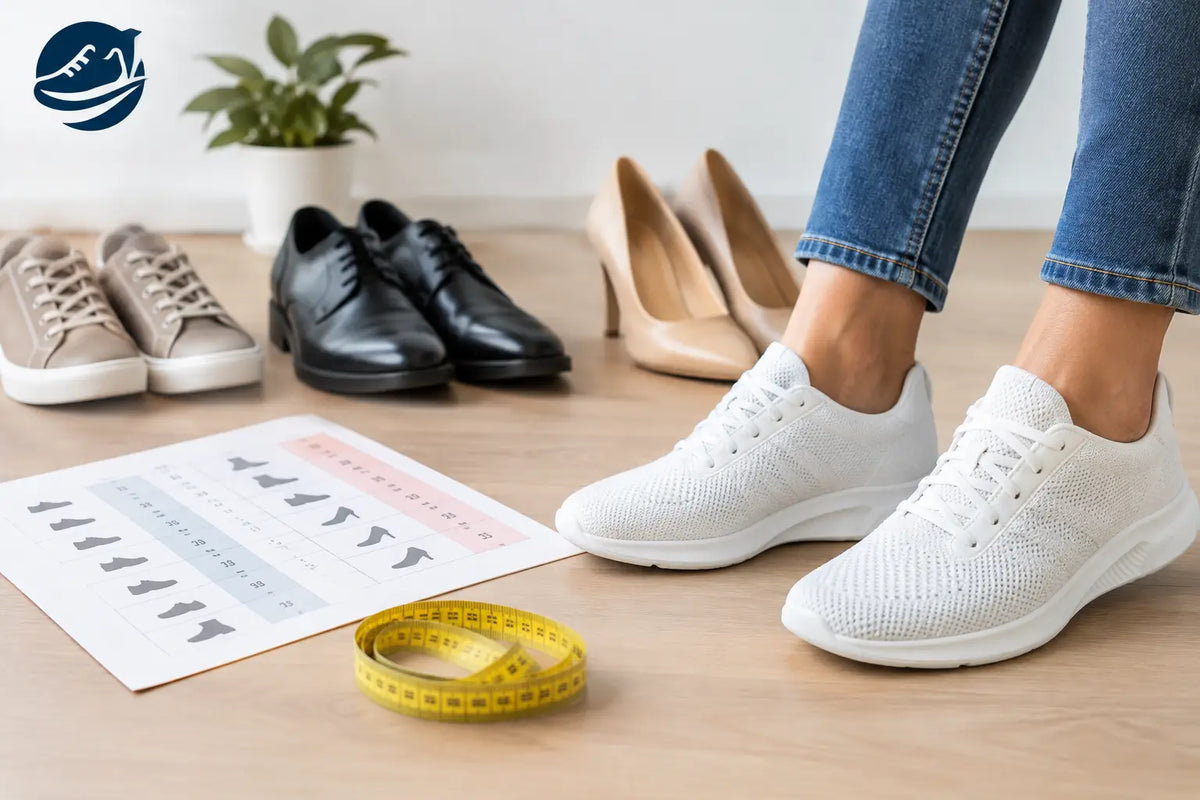
A sharp silhouette loses its force when the fit is wrong. US shoe size conversion is more than matching a number on a chart - it is the difference between footwear that moves with confidence and a pair that stays in the box.
Size labels vary by market, category, material, and even the shape of the toe. Use conversion charts as a strong starting point, then let your actual foot measurements and the fit notes for the specific pair make the final call. Precision looks better.
Why Shoe Sizes Are Not Universal
A US size is not a fixed physical measurement. It is part of a sizing system, and that system differs from European, UK, and centimeter-based sizing. A men's US 9, for example, may commonly align with a European 42, but that does not mean every shoe labeled EU 42 will feel identical.
The last - the foot-shaped form used to build a shoe - changes the fit. A sleek pointed-toe boot may feel more restrictive than a rounded sneaker at the same marked size. Leather can relax with wear, while a structured synthetic upper may hold its original shape more closely. Insoles, padding, sock thickness, and your individual arch all matter.
That is why a conversion chart should never overrule discomfort. Your footwear should feel intentional from the first step, not like a compromise you hope will improve later.
US Shoe Size Conversion by Region
For adult footwear, US women's sizing is generally about 1.5 sizes higher than US men's sizing when referring to the same approximate foot length. A US women's 9 often converts to a US men's 7.5. This is a useful rule, but it is not a guarantee across every design.
European sizes are unisex in numbering, though the fit and width of the shoe may still be designed around a men's or women's last. UK sizes run differently from US sizes, and the difference is not always a clean one-size shift. Use the chart below as a practical reference for common adult conversions.
| US Men's | US Women's | EU | UK | Foot Length Approx. |
| --- | --- | --- | --- | --- |
| 6 | 7.5 | 39 | 5.5 | 9.25 in / 23.5 cm |
| 7 | 8.5 | 40 | 6.5 | 9.6 in / 24.4 cm |
| 8 | 9.5 | 41 | 7.5 | 9.9 in / 25.2 cm |
| 9 | 10.5 | 42 | 8.5 | 10.25 in / 26 cm |
| 10 | 11.5 | 43 | 9.5 | 10.6 in / 26.9 cm |
| 11 | 12.5 | 44 | 10.5 | 10.9 in / 27.7 cm |
| 12 | 13.5 | 45 | 11.5 | 11.25 in / 28.6 cm |
These are approximate matches, not a promise of identical fit. If you are between sizes, the right answer depends on the shoe. For narrow, structured, pointed, or non-stretch styles, sizing up can give your toes the room they need. For a relaxed leather loafer or a roomier sneaker, your standard size may be the cleaner choice.
Men's and Women's US Sizes
The 1.5-size difference is helpful when shopping across categories. If you usually wear a men's US 10, a women's US 11.5 is the closest equivalent by length. If you wear a women's US 8, begin around a men's US 6.5.
Width is the variable that often gets missed. Men's footwear is frequently built on a wider last, while women's footwear can be narrower through the heel and midfoot. Someone with a wider foot may find the cross-category conversion works beautifully. Someone with a narrow heel may need extra attention to fit, especially in slip-on styles.
European Sizes Need a Closer Read
European sizing appears simpler because it often uses one shared scale. In practice, whole EU sizes cover a wider range than many US half sizes. A person who sits between US sizes may find both nearby European sizes plausible, depending on the shoe's profile.
Do not assume an EU 42 is always the same as a US men's 9. It is usually in that range, but one model may wear closer to a US 8.5 while another feels like a 9.5. Check the product's stated measurements whenever they are available, particularly with boots and fashion-forward shapes.
Measure Your Foot Before You Order
The cleanest way to choose a size is to measure the foot you actually have, not the number you remember from a pair you bought years ago. Feet can change over time, and one foot is often slightly longer than the other.
Place a sheet of paper against a wall on a hard floor. Stand with your heel lightly touching the wall and your weight distributed naturally. Mark the tip of your longest toe, then measure from the paper's edge to that mark. Repeat with the other foot and use the longer measurement.
Measure in the afternoon or evening when your feet have had time to expand naturally. Wear the sock thickness you expect to use with the shoes. A thin dress sock, bare ankle, and cushioned athletic sock can each change how a pair feels.
Once you have your measurement in inches or centimeters, compare it with the specific size guide rather than relying only on your usual US number. Foot length gives you the most stable reference point when international labels get confusing.
Fit Signals That Matter More Than the Number
A new shoe does not need to feel loose, but it should not demand pain as an entry fee. Your heel should stay controlled without rubbing or lifting excessively. The ball of your foot should align with the widest part of the shoe, and your toes should have enough room to rest without pressing hard into the front.
For closed-toe footwear, leave roughly a thumb's width between your longest toe and the end of the shoe. This space matters most in boots, sneakers, and styles you will wear for extended periods. Your foot moves forward as you walk, especially on stairs and pavement.
Pay attention to pressure across the instep and sides. A shoe that pinches across the widest part of your foot is usually too narrow, not simply too short. Going up a full size may add unwanted length without solving the real issue. If widths are offered, choose the width that matches your foot first.
When to Size Up
Consider sizing up by a half size if you are between sizes and the shoe has a narrow toe box, a high vamp, heavy structure, or little stretch. The same logic applies if you plan to wear thicker socks or use orthotic insoles.
Sizing up is also sensible when your longer foot sits at the top end of the listed measurement range. You can improve minor extra room with an insole or slightly thicker sock. You cannot create length where there is none.
When to Stay True to Size
Stay with your standard size when the shoe has a rounded or generous toe box, a flexible upper, or a fit guide that describes the style as roomy. Leather may soften around the width over time, but it should never begin with crushed toes or sharp pressure points.
Avoid buying a smaller size because you expect leather to stretch. It may give slightly across the forefoot, but it will not meaningfully grow in length. A refined fit is secure, balanced, and comfortable enough to carry your presence through the day.
Kids' Sizes Are a Different System
Children's US sizes do not align directly with adult sizing. Youth sizing progresses through toddler and little-kid ranges before reaching big-kid sizes, which commonly run from 1Y to 7Y. After that, the equivalent foot lengths may overlap with adult sizes, but the conversion varies by manufacturer and shoe construction.
For children, measure often and prioritize growing room without choosing a shoe so large that the foot slides around. About a thumb's width at the toe is a practical target. A secure heel and stable midfoot matter more than extending wear time from a pair that is already too tight.
The Final Check Before Checkout
Before ordering, compare your measured foot length with the size guide for that exact shoe. Then read the fit description: narrow, true to size, oversized, structured, flexible, or intended for a sockless fit. Those details carry more weight than a generic chart.
If you are choosing between two sizes, think about how you will wear the pair. A sleek boot for evenings, a daily sneaker for long walks, and a loafer worn without socks each call for a different level of room. The right size is not just a label. It is the foundation for footwear that looks composed, feels controlled, and lets the rest of your style do the talking.