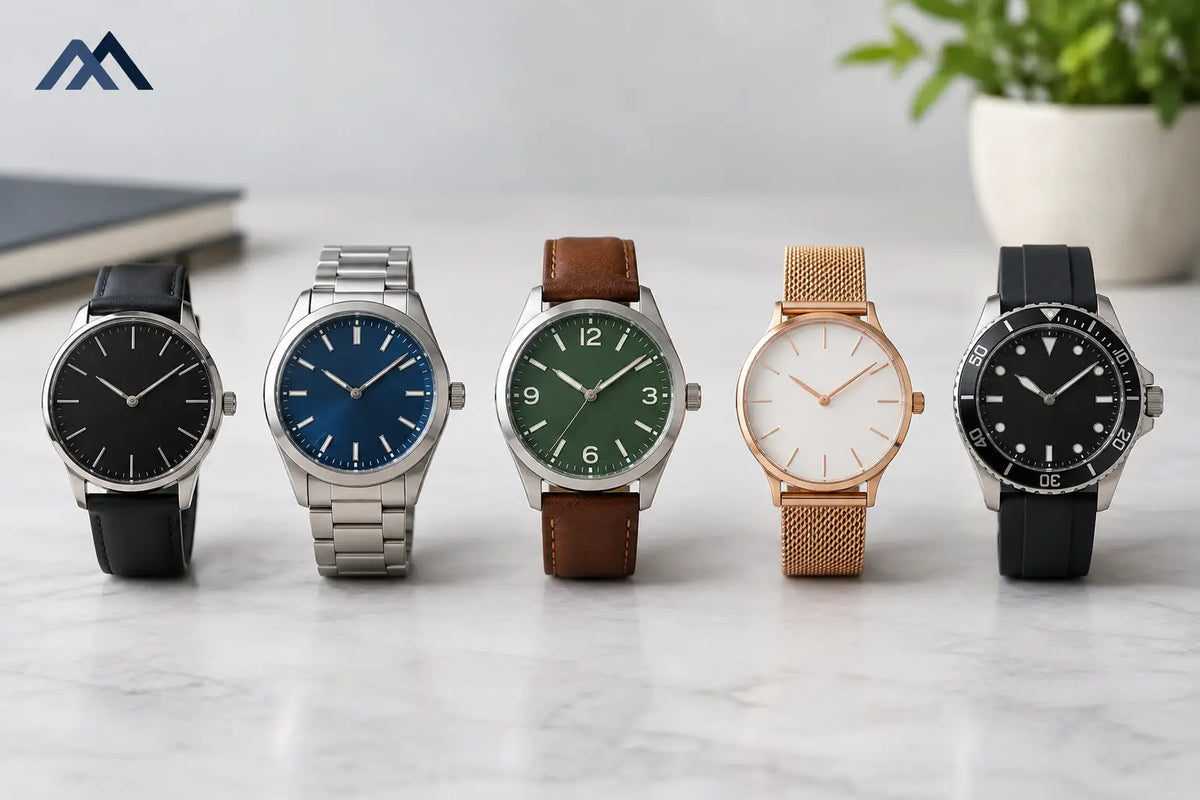
A watch can be impeccably designed and still miss the mark if its proportions are wrong. That is why a watch size comparison matters before you commit. The right case does more than tell time - it controls the balance of your wrist, sharpens your outfit, and decides whether your look feels intentional or overworked.
Size is not about following a rule written for someone else. It is about choosing the amount of presence you want to carry. A slimmer, smaller watch can read precise and controlled. A larger skeleton dial can project confidence from across the room. Both work when the scale is right.
Watch Size Comparison Begins With the Case
When people refer to watch size, they usually mean case diameter: the width of the watch face measured in millimeters, excluding the crown. It is the first number to consider, but not the only one.
For most wrists, a case between 38mm and 42mm sits in the strongest all-around range. It has enough visual authority for daily wear, yet remains refined under a cuff. Watches at 34mm to 38mm tend to feel more discreet, vintage-inspired, or jewelry-like. Cases from 43mm upward make a deliberate statement and need enough wrist real estate to look composed rather than crowded.
A useful starting point is your wrist circumference:
- Under 6.25 inches: 34mm to 38mm usually offers the cleanest balance.
- Between 6.25 and 7 inches: 38mm to 41mm is a versatile range for most styles.
- Between 7 and 7.75 inches: 40mm to 44mm can look proportionate and substantial.
- Above 7.75 inches: 42mm to 46mm can carry strong presence without overwhelming the wrist.
Diameter Is Only Part of the Watch Size Comparison
Two watches with the same diameter can wear completely differently. The details decide it.
Lug-to-lug length controls wrist coverage
Lugs are the extensions that connect the strap or bracelet to the case. Lug-to-lug is the full distance from the tip of one lug to the other. This measurement often matters more than diameter because it tells you how much of your wrist the watch actually spans.
As a clean rule, the lugs should not hang past the edges of your wrist. When they do, the watch can look rigid and top-heavy, especially on a leather strap. A 40mm case with compact lugs may wear smaller and cleaner than a 38mm case with long, angular lugs.
If you prefer a strong watch without excessive bulk, prioritize a compact lug-to-lug measurement. It delivers presence with restraint.
Case thickness changes the profile
Thickness is the vertical height of the case. A watch can look proportionate from above but feel oversized from the side if it is too thick for your wrist or wardrobe.
Ultra-thin watches tend to sit close to the wrist and slide easily beneath a shirt sleeve. They are built for a polished profile: tailored jackets, dark knits, crisp shirts, and evenings where the details do the talking. A thicker watch has more visual weight. It can feel athletic, architectural, or boldly masculine depending on the dial and finish.
There is a trade-off. Thin cases are elegant, but they may not deliver the same mechanical depth or dramatic dial presence as a thicker design. Thicker cases command attention, but can fight with fitted cuffs. Choose the profile that matches how you actually dress, not just the image you want for one night out.
Dial design can make a watch look larger
A minimal dial with a wide open surface often reads larger than its measurement suggests. High-contrast markers, bright metal hands, and skeletonized details draw the eye outward and amplify visual scale. A dark dial with a slim bezel can feel commanding even at 39mm.
Conversely, a thick bezel reduces the visible dial opening and can make a larger watch feel more contained. This is why numbers alone never tell the full story. Look at the case, dial, bezel, and lugs as one silhouette.
Match the Watch to Your Wrist Shape
Wrist circumference gives you a baseline. Wrist shape refines it.
A flatter, wider wrist can often support a larger diameter because the case has more surface area to rest on. A rounder or narrower wrist may look best with shorter lugs, a curved caseback, and a case that does not extend to the edges. If your wrist is especially slim, do not assume you must choose a small watch. A 40mm piece can still work if its case is thin and its lugs are compact.
The same principle applies across all styles. Watch sizing is not divided by outdated labels. It is a question of proportion, comfort, and the message you want the piece to send. A compact gold-tone watch can be sharp on any wrist. So can a larger black skeleton dial, provided it sits with control.
The Strap Has More Power Than You Think
The strap changes both comfort and perceived size. A metal bracelet adds density and makes a watch feel more substantial. It is a strong choice when you want a clean, elevated finish that can move from work to dinner without losing edge.
Leather creates a more tapered outline and often makes the same case look slightly slimmer. It can soften a large watch or give a thin watch a more traditional, dressed-up profile. A wide strap adds weight. A narrow strap adds refinement.
Pay attention to strap width where it meets the case. On most designs, a strap around half the case diameter looks balanced. For example, a 40mm case commonly pairs well with a 20mm strap. This is not a hard formula, but extreme proportions can disrupt an otherwise strong design. A very narrow strap under a large case can make the watch look top-heavy. An oversized strap on a compact case can feel forced.
Fit matters as much as appearance. Your watch should stay in place without digging into the wrist or rotating constantly. Leave enough room for comfort, but not enough for the case to slide over the wrist bone every time you move.
Choose Size Based on the Presence You Want
A smaller watch is not less confident. It is controlled confidence. A 36mm to 38mm case works when your style is minimal, tailored, or jewelry-forward. Think sharp monochrome fits, clean sneakers, rings, chains, and details that reward a closer look.
A 39mm to 41mm watch is the modern center point. It works with denim, overshirts, knitwear, formal shirts, and most footwear silhouettes. If you are buying one watch to cover the most ground, this range is difficult to beat.
A 42mm to 44mm watch has a different purpose. It is built for presence. It suits broader wrists, relaxed streetwear, heavier jackets, bolder footwear, and outfits with enough visual weight to support it. A larger case can also be the right move if the watch is meant to be the focal point rather than a finishing detail.
Ask one direct question: do you want the watch to be noticed immediately, or discovered gradually? There is no wrong answer. There is only the right proportion for your image.
How to Test a Watch Size Before You Wear It Out
Do not judge fit from one mirror glance. Fasten the watch, lower your arm, and look at it the way other people will see it. Then raise your wrist as if checking the time. The case should feel centered, the lugs should remain within your wrist line, and the crown should not press into your hand when you bend it.
Try the watch with the sleeve you wear most. A piece that looks perfect with a T-shirt may be too tall under a fitted cuff. Take a photo from a few feet away as well. Close-up mirrors exaggerate size; photos reveal overall proportion.
Most of all, trust the reaction you have when you put it on. The right watch does not ask for approval. It settles into your look and makes everything around it feel more deliberate. Choose the size that gives you that effect, then wear it like it was always yours.
The VALTRYXX watch collection is built on the same standard — clean lines, considered materials, nothing wasted.