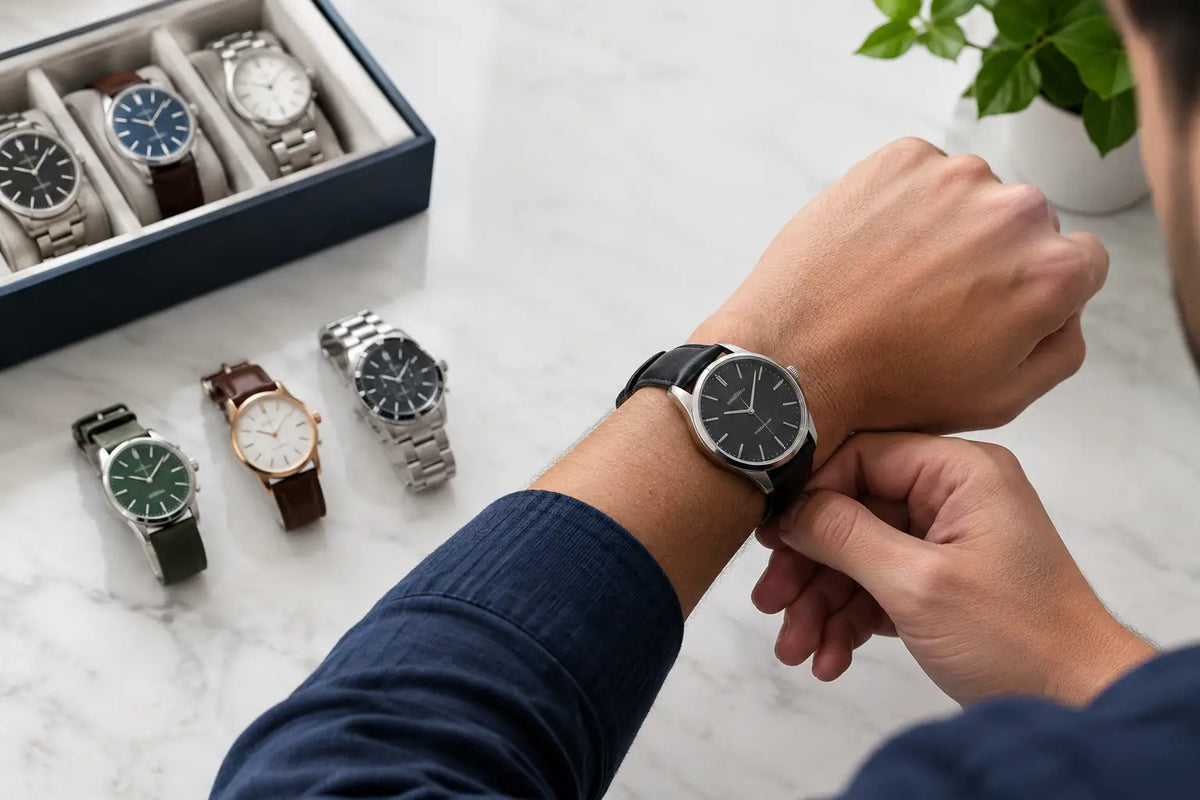
A watch can be technically beautiful and still look wrong the second it hits your wrist. Too small, and it loses the presence you bought it for. Too large, and it looks like the watch is wearing you. Knowing what watch size fits wrists comes down to proportion, not arbitrary rules - and getting it right changes the entire effect of your look.
The strongest fit feels intentional. The case sits within the edges of your wrist, the strap follows its shape, and the dial has enough visual weight to register without demanding attention. That is refined presence.
What Watch Size Fits Wrists: Start With Your Measurement
Measure your wrist where you normally wear a watch, just above the wrist bone. A flexible tape measure gives the cleanest result, but a strip of paper and a ruler work just as well. Wrap it comfortably, mark the overlap, and measure the length in inches or millimeters.
Wrist circumference is a useful starting point, but it is not the final answer. A flat wrist can carry a broader case than a round wrist with the same measurement. Your height, hand size, wardrobe, and the design of the watch all influence the result. Think of the measurement as the frame. The watch is the statement inside it.
For most people, these ranges create a confident baseline:
- Wrists under 6.25 inches: 34mm to 38mm cases usually sit cleanly.
- Wrists from 6.25 to 7 inches: 38mm to 40mm is a strong all-purpose range.
- Wrists from 7 to 7.5 inches: 40mm to 42mm brings balanced presence.
- Wrists over 7.5 inches: 42mm to 44mm can look proportional without feeling oversized.
Case Diameter Is Only the First Number
Case diameter gets most of the attention because it is easy to compare. It is the width of the watch case, measured straight across the dial, excluding the crown. In general, a larger diameter creates a more assertive, modern profile. A smaller diameter feels cleaner, more tailored, and often more versatile.
But two watches with the same diameter can look completely different. A 40mm ultra-thin dress watch with a narrow bezel may appear larger across the wrist than a 42mm sport-inspired piece with a thick bezel and compact dial opening. Dark dials tend to visually recede, while bright or skeletonized dials draw the eye and feel more expansive.
If you want one watch to move from work to dinner to a late-night room, 38mm to 40mm is often the sweet spot. It has enough authority for an open cuff or rolled sleeve, yet it remains composed beneath a jacket. A 41mm or 42mm case delivers more impact when you want the watch to lead the look rather than quietly complete it.
Lug-to-Lug Decides Whether It Really Fits
The most overlooked watch measurement is lug-to-lug. This is the distance from the top lug to the bottom lug, or the points where the strap connects to the case. It determines how much real estate the watch occupies from one end of your wrist to the other.
For a precise fit, the lugs should not extend beyond the edges of your wrist when viewed straight on. If they do, the case can look awkward, even if its diameter seems reasonable. This is why a 40mm watch with a 46mm lug-to-lug can wear compact, while another 40mm case with a 50mm lug-to-lug can feel much larger.
As a practical guide, many smaller wrists look strongest with lug-to-lug measurements around 44mm to 47mm. Average wrists often land comfortably between 46mm and 49mm. Larger wrists can generally handle 50mm and beyond. Still, curved lugs soften the footprint, while straight, angular lugs create a broader visual stance.
A watch should sit on the wrist, not bridge it. That distinction is small in measurement and massive in appearance.
Thickness Changes the Watch’s Attitude
Case thickness is where elegance and presence take different paths. A slim watch, usually around 6mm to 9mm thick, slides easily under a shirt cuff and gives off controlled, architectural confidence. It is the right choice when your style leans minimalist, tailored, or monochrome.
A case around 10mm to 12mm is the versatile middle ground. It has enough depth to feel substantial but does not dominate the wrist. Above 12mm, a watch becomes more physical and casual. That can work well with textured layers, heavier footwear, and relaxed fits, but it asks for more wrist space.
Thickness also affects comfort. If you spend long hours at a desk or prefer close-fitting sleeves, a thinner profile tends to disappear in the best possible way. If you want a watch that reads as a visible piece of your look, more depth gives it stronger visual weight.
The Strap Can Make a Watch Wear Bigger or Smaller
Do not choose case size in isolation. The strap is part of the silhouette.
A metal bracelet adds visual mass and makes a watch feel more substantial. It is a strong option when you want a polished, structured finish. Leather and leather-look straps create a leaner profile, especially in black or deep brown. A narrow strap can make a larger case feel even larger by contrast, while a wider strap can anchor it.
The right strap should sit close to the case without looking pinched. On smaller wrists, an 18mm or 20mm strap often keeps the watch proportional. On larger wrists, 20mm to 22mm generally creates the right balance. Tapered straps are especially effective because they keep the case looking decisive without adding unnecessary bulk around the underside of the wrist.
Fit matters here too. A bracelet should have slight movement, roughly enough room for one finger beneath it, without spinning around your wrist. A strap should be secure but never leave an imprint. Luxury looks effortless. Discomfort is visible.
Match the Size to the Statement
There is no single “correct” size because watches have different jobs. The right piece for a clean office look may not be the one you reach for with a black tee, sharp denim, and statement footwear.
A smaller, ultra-thin case signals restraint. It works when the rest of the outfit is already strong and you want the details to reward a closer look. A medium case is the most adaptable choice, especially if this is your first serious everyday watch. It holds its own across settings without becoming the entire conversation.
A larger case projects immediately. It suits people with bigger wrists, bolder proportions, or a style built around visible accessories. Skeleton dials can amplify that effect because their layered mechanics create more visual intensity. If you prefer a clean, discreet presence, consider sizing down slightly when choosing an open-worked dial.
The case color matters as well. Black cases often feel sharper and more compact. Gold-tone finishes bring warmth and attention, which can make the same diameter feel more prominent. Silver-tone cases are adaptable and balanced, changing character with the outfit around them.
Try the Mirror Test Before You Commit
Numbers narrow the field. The mirror makes the final call.
When you try on a watch, stand naturally with your arm at your side, then look at it from normal conversation distance. Do not judge it only from six inches away. Ask whether the case stays within your wrist boundaries, whether the strap matches the weight of the case, and whether the watch supports your outfit rather than competing with it.
Then check it under a sleeve. A watch that catches awkwardly on every cuff may be too thick for your daily uniform, no matter how good it looks in a product photo. If it feels balanced with your clothes and you stop noticing the fit after a few minutes, you are close.
Your watch does not need to be loud to have power. It needs to look chosen. Find the proportion that feels natural on your wrist, then wear it like it was built for your presence.
The VALTRYXX watch collection is built on the same standard — clean lines, considered materials, nothing wasted.